Showing posts with label instruments. Show all posts

Wednesday, January 24, 2018

Mr. Music Man

The kindergarten students learned about several of the different classroom instruments we have and how to play them. After naming and demonstrating each instrument, I placed 6 hula hoops around the room and put one of each instrument inside the hoop. I then split the class into groups of 3-4 and had them sit around each hoop. We did an echo activity to allow each student a chance to play every instrument. They started out by picking an instrument from the hoop and then I played a rhythm on the drum and they echoed back. Then, they put that instrument down and picked up another one. I did this very quickly so students didn't have time to argue or play out of turn and also so that they had a chance to play all of the instruments at least once.

After that activity, I let the students create a Music Man out of the instruments. They could make one big one or two small ones, but they had to work together to make it look like a person. Here are some pictures of what they came up with!


Monday, January 8, 2018

Invented Instruments

I had an epiphany this year with our Invented Instruments project. Each year, the 6th graders invent their own instruments and compose a sound piece to be played on their instrument. Normally, I have them perform their sound piece in class and then I display their instruments in the hallway for a few weeks. This year, there was so much interest in the project from other classes and teachers, that I decided we needed to show them off a bit more! We took one class period and moved down to the lunchroom where each student set up with their instrument and sound piece and then we invited the entire school to come listen. Teachers were able to bring their classes to the lunchroom if they had time and students walked around listening to each of the instruments perform. This was a great way for them to get to hear what they sounded like and also gave the 6th graders a chance to explain what their instrument was made of and how it worked. Each student got to perform roughly 10-20 times! 


Friday, March 24, 2017

Invented Instruments

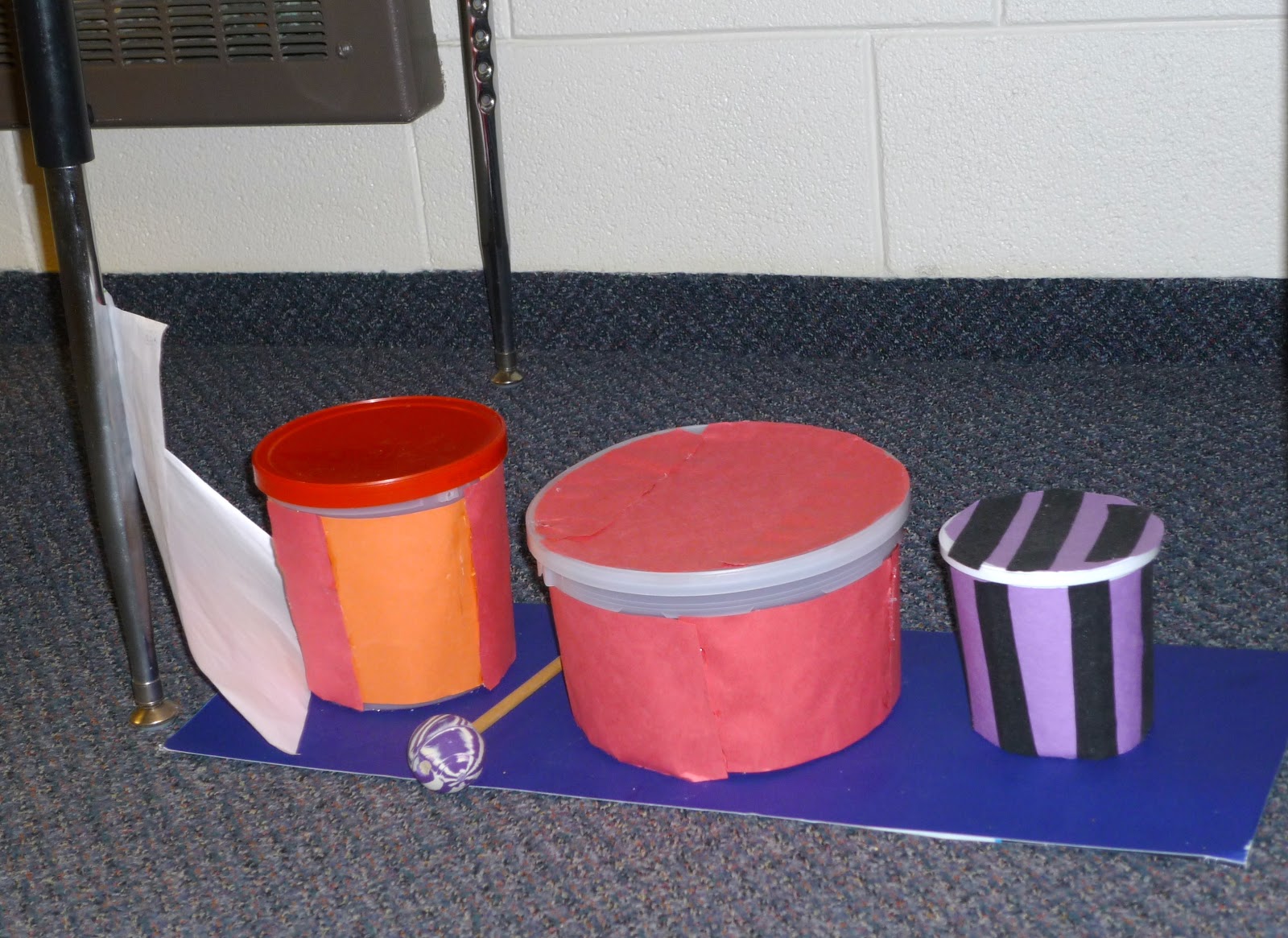
Here are the invented instruments from this year's 6th graders. Once again I was blown away by the creativity of some of my students! They are sorted into aerophones, idiophones, chordophones, and membranophones. Instruments are required to be homemade, make 3 or more pitches, and be sturdy, decorated, and "finished" looking. Students also composed a sound piece to be performed on their instrument using iconic notation.


Tuesday, November 10, 2015

"Apple Tree" Orff rotation

My 1st graders are working on playing the steady beat on an instrument. Eventually I will assess them on playing a steady beat bordun. We practiced this by rotating through a series of instruments and playing the steady beat while singing the song. I set my rotation up so that every student would have an instrument all the time. This seems a bit crazy, but I found that it worked better than when I used to just line all of the students up behind the xylophones and metallophones only. When I did it that way, only 5 students could play at a time and the other 20 quickly got off task. This way, everyone has something to play every time and stays focused.

I set the instruments up so that there was a barred instrument every 2 or 3 instruments. I also used a variety of drums and woodblocks to have different timbres. We played through the song one time and then chanted "One, two, three, four. Mallets down get off the floor. Five, Six, Seven, Eight, Hurry don't be late!". By the end of the chant, each student was at the next instrument and ready to play. We rotated through about 8 instruments and the students never got tired of playing the same song over and over again.

Tuesday, November 4, 2014

Invented Instruments

The 6th graders just completed one of my favorite units, Invented Instruments. We spent at least 3-4 weeks working on this project.

First, we discussed the 4 different ways we can classify instruments based on the way they make sound: aerophones (air vibrates), chordophones (a string vibrates), idiophones (solid matter vibrates), and membranophones (a stretched skin vibrates).

Then, we researched different instruments that we could make using common household items such as cans, string, paint, or wood. We spent a class in the computer lab looking up ideas for homemade instruments. Once they had decided on what to make, the students had to classify it as either a chordophone, aerophone, idiophone, or membranophone. They also had to make sure that their instrument made at least 3 different sounds and could play both loud and soft dynamic levels. All instruments needed to be decorated and finished looking.

One week was spent building the instruments (in class or at home) and then the next week was spent composing a sound piece that would be performed on the instrument. The sound piece had to last between 20-40 seconds and would be performed in front of the class. We used numbers, letters, or symbols to notate our pieces.

Here are some pictures of what the students created. You'll be amazed at how creative some of them were!


Friday, October 24, 2014

Bow Wow Wow!

The 3rd and 4th graders have been studying the pentatonic scale. I found a great pentatonic pack on TeachersPayTeachers with lesson plans, activities, assessments, and Powerpoints. It has been extremely helpful and the kids have loved the lessons. One of the first lessons is for the song "Bow Wow Wow". While singing the song, we include triangles, a xylophone ostinato, and a dance. Every kid has a job to do and we rotate through each position. Instruments, dancing, and singing in one lesson... What's not to love?!

Thursday, October 23, 2014

So-Mi-La Songs

2nd graders have been spending a lot of time reviewing So, Mi, La this year. We spent the last two weeks composing a SML song. First, we created an 8-beat rhythm pattern using tas and ti-tis. Then we added pitches to those rhythms. Finally, we notated those onto a staff. We drew a treble clef and discovered that our piece was in 2/4 time. We also had to learn about bar lines, so this was a great review project for lots of things!

This was our first real practice putting notes onto a staff, so it took a bit of time for some of the kids to grasp drawing notes on lines and spaces (something I realized I need to spend more time on in 1st grade when we learn about lines and spaces). After they had notated their song onto the staff, I gave each student a glockenspiel to practice their piece. Once everyone was done, they performed their piece on the xylophone for the class. The students loved showing off what they had written!
On a side note, if I could do one thing differently, I think I would have had the staff notation on a separate page. That way, when the students played it on the instruments, they were reading from the staff notation and not the rhythmic notation they had on top.

Wednesday, May 22, 2013

Improvisation and Partner Assessment

The 2nd graders recently learned about improvisation. We created a rhythmic pattern, and then improvised a melody on the xylophones and metallophones using the pentatonic scale.

Then we discussed what things were important to do when improvising on the instruments. We decided on 5 things: steady beat, correct rhythm, mallets bounced off the bars, proper hand position, and the melody should end on 'C'. The students paired up and graded their classmates on these 5 things. It was great seeing them play teacher for the day. They gave positive feedback as well as constructive feedback.


Students on the left, teachers on the right.

Teachers on the left, students on the right.

Monday, November 26, 2012

Instrument Inventions

I found a great lesson on a blog I follow (http://bethsmusicnotes.blogspot.com) for creating instruments. First, we studied Ethnomusicology-The study of instruments of the world. We learned that there are 4 categories of world instruments based on what vibrates to make their sounds. Aerophones (air), Chordophones (strings), Membranophones (stretched skin), & Idiophones (solid matter). We then set out to create our own instruments to fit into one of these categories. Instruments were to be made from everyday household materials and had to make at least 3 sounds. No labels or brand names were allowed to be showing and they were to look professional. The instruments they came up with far exceeded my expectations!

After creating their instruments, they then had to compose a sound piece and perform it for the class. A sound piece is a modern form of composition that uses symbols, shapes, colors, and numbers rather than traditional music notation. They needed to include dynamics and it had to be between 20 & 40 seconds long. These were also great! I've posted pictures below of a few of the instruments and sound pieces that were created.

Idiophone & Sound Piece

Idiophone

Idiophone

Chordophone & Sound Piece

Idiophone (top left), Membranophone (top middle), Aerophone & Idiophone (top right)
Sound Piece to go with the Chordophone next to it (bottom)

Membranophone & Sound Piece

Various Idiophones and Membranophones

Chordophone & Sound Piece

Idiophone

Sound Piece to go with the Idiophone pictured above.

Idiophone

Tuesday, April 3, 2012

Old McDonald

The 2nd graders learned to accompany Old McDonald on the xylophones and metallophones. We used an F Pentatonic scale and practiced a broken bordun. This activity is great for keeping a steady beat and working on coordination.