Showing posts with label 5th grade. Show all posts

Monday, April 4, 2016

Eggcellent Rhythms

The 5th graders have been learning about 6/8 time and I found a great Easter activity in my Kids Can Compose book. Using an egg carton and a bunch of eggs labeled with different rhythms, we had a giant egg hunt. Each group had to find 6 eggs, then using their 6 eggs, they had to compose as many measures as possible in 6/8 time. Then I passed out the worksheet from the book and they had to compose 2 different measures using only the rhythms on their eggs. Once they finished that, they joined another group to create a 4-measure pattern that they practiced and presented to the class.


I really liked this lesson because the egg cartons have 6 slots in each row which makes them perfect for doing 6/8 time. One slot=one beat which was a great visual for the kids. I've done this lesson with younger kids in 4/4 time and they are always confused by the extra two spaces. It is also really good for critical thinking and problem solving because they have to come up with several ways to use the same 6 eggs in different ways.


Looking for eggs!


Two groups combined performing their 4-measure composition.

An example of a finished sheet.

Tuesday, November 10, 2015

Surround the State in Song

"Surround the State in Song" was a great event again this year! I've posted about this every year, but if you don't know what "Surround the State" is, it is a 5th and 6th grade honor choir hosted by the ND ACDA chapter. Students from all over the state attend a day-long rehearsal at 5 different locations around North Dakota. They rehearse the same songs and perform a concert at exactly the same time, 4:00. This way, the students are literally surrounding the state in song! What a cool concept!

I took 7 students from my 5th and 6th grade chorus. We also have choir members from a private Catholic school and some of those students attended as well. Here are some pictures from our day.
A little break between rehearsals!

Don't they look good?!

The members from our choir! So proud of these young people!! :)

Wednesday, September 30, 2015

Chair Rhythms

I have been looking for a way to help students remember the difference between the number of beats and the number of sounds that notes get. I decided to try chair rhythms with my 5th graders because I thought it would also be a good way to practice our new rhythm, short-long, short (prep for syncopa). It got a bit noisy and a bit cozy, but I think it worked! Here's what we did:

1. I put 4 chairs in the front of the room and explained that each chair equaled one beat.
2. I had one person sit in each chair. The class was able to figure out that they were quarter notes.
3. I had 2 students sit on each chair and the class discovered they were ti-tis (or pairs of eighth notes).
4. I had 4 students on each chair (this is where things got a bit cozy!) and they discovered they were tika-tikas (4 sixteenth notes). I stopped here to re-explain that they were 4 sounds on 1 beat. NOT 4 beats long.
5. I had 3 students sit on each chair. The first time I had one student sit on the lap of the person on the left and then one person next to them. This was a tika-ti (2 people had to share half a chair/beat). Then we figured out how to make a ti-tika.
6. I had 1 student lay across two chairs. The class discovered this person was a half note. I did the same with 3 chairs for dotted half and 4 chairs for whole note. By this point the kids were starting to really understand. YAY!!
7. The last step was to make 3 people fit on 2 chairs to create our short-long-short. After telling the 2 outside people they only got half of a chair and the middle person got 2 halves (or a whole), kids started putting together the pieces and trying to guess what rhythms made up a short-long-short pattern. Some of the kids were really close to discovering it was eighth-quarter-eighth, but I didn't reveal that answer just yet.
8. The last thing I did was split the kids into 2 groups. Their group had to form a rhythm using all of their group members and the other group had to notate it. Now they had to use some math to decide how to divide themselves up among the four chairs!

Like I said, it got a bit noisy and a bit uncomfortable at times, but I think the lesson really worked well. Kids were problem solving, drawing conclusions, and notating rhythms. And they had fun!! Woohoo!
A Whole Note!

Tika-tika, tika-tika, ta, ti-ti

Ti-ti, tika-tika, ta, tika-tika


Friday, September 11, 2015

Write the Room

I discovered a new review activity this summer called "Write the Room". My 5th graders are studying music symbols and I thought this would be an easy way to review the first 8.  I created cards with music symbols on them and their name and definition. I posted these cards around the room. Then, each student gets a sheet to fill out. They walk around the room finding each symbol and fill out their sheets. It's a great way to get them up and moving, and having the symbols spaced out around my room kept the kids from getting too congested in one area. For the more advanced kids that already knew the symbols, I had them try to fill out their sheets without looking first, and then walk around to check their answers.

Here are the sheets I made. They can be edited to include any other symbols you would want to use. I've also seen this done with rhythms.


Tuesday, March 24, 2015

Note Name Centers

I LOVE using centers in my classroom. It is a great way to practice concepts using games instead of group questioning or worksheets. I usually create 4-5 centers, depending on the size of the class. I generally don't like to have more than 4 in a group. I recently completed a large center rotation for my 5th graders studying bass clef and they loved them so much, I duplicated them the next week for my 4th graders who were starting to learn treble clef. In my 5th grade class, I spent one day doing a group lesson on bass clef. After that, they worked completely independently in their groups. After they had finished all 5 centers, I gave them the test. Every single student passed with flying colors!!

Here are the centers I used for treble clef and bass clef. I created directions for each one so I wouldn't have to repeat them each day. I made the directions general so they can be used for either treble clef or bass clef.


Mad Minute: I always like to have one worksheet station so I make sure that every kid is understanding the concept being taught. I created a Mad Minute note name sheet at a great website I discovered: http://secondrunnerup.com/mmmusic/form.php.  After they have finished all 30 questions on the Mad Minute, they work on some kind of note-naming worksheet.  I got my worksheets for this station from www.makingmusicfun.net (I like the crossword puzzles the best). For treble clef, I also added in a worksheet that helped the students practice drawing treble clefs. For the bass clef, I added a worksheet that gave them a chance to create their own pneumonic devices for remembering the lines and spaces. They really have fun coming up with  new phrases!


Name That Tune: This is another worksheet I got from www.makingmusicfun.net . The group works together to name the notes and then plays them on the Boomwhackers. It is really fun to watch the kids work together to figure out each song. When we do this with bass clef, I put the octavator caps on them to make them sound lower.


Connect Four: This is another fun game I could never do with the whole class. There is a new version of Connect Four called Connect 4x4 that is a 4-player game instead of 2. Students must correctly answer a flashcard to get a turn. Fun, simple, and it makes them think strategically!


Goldfish Spelling: You can never go wrong bribing your kids to learn with food! This was definitely one of the most anticipated stations! I made a goldfish bowl template and stuck it in a plastic sleeve (I call them lap packs and they are actually filled with lots of papers that I use for different lessons). Each kid gets 7 goldfish and a pile of spelling words. They use the fish as notes to spell each word on the staff. And of course, once they are done, they get to eat them!!


iPad Station: I am always looking for ways to use the iPads. I downloaded the Noteworks Free app which has a really fun treble clef game on it. Unfortunately, I didn't realize that the free version only covered middle C-G. On the plus side, they are getting lots of practice with middle C and low D, two of the most common notes students get wrong on the test.


Swat the Staff: Since I don't have an iPad game for bass clef, I use this game instead.  A large bass clef staff is projected on the board and two students race to swat the correct line or space with a flyswatter. The kids love this game and it sometimes gets very competitive.

Mitten Memory Match: I bought a bunch of bulletin board decorations at Target last fall with the hopes of making them into different games. I used the gloves to create a memory game ( I know- they're gloves and I called it Mitten Memory Match-it just has a better ring to it!). I wrote the note on the staff on one card and the letter name on another.

I also have a game called Musical Pairs that I purchased that uses sharps and flats. This is a little more challenging because there are more cards, but it does give the answer on the bottom, so they don't really have to figure out the note name.

If you haven't tried centers in your classroom, I highly recommend them! They are a great way to keep your students engaged. Once you have your centers created and set-up, the students are really doing all of the work, leaving you to simply walk around the room and monitor what they are doing! Everybody wins!!

Tuesday, March 3, 2015

Valentine's Day Fun!

I am a little behind this month, but here is my massive post of all of the fun Valentine's Day activities we did last month. It was a little crazy because I also had my 1st and 2nd grade musical and a music contest in February, but we did manage to get some Valentine-themed lessons covered.

"A Song for My Sweetart"
This is a lesson idea from the book "Kids Can Compose". I always have one of those giant bags of mixed candy on hand for Bingo prizes and such, and luckily the last bag I bought was FULL of Sweetart candies. The Sweetarts came in packets similar to Smarties, so it was easy to distribute them to each of my groups. Everyone simply got one packet to share.

The 4th graders are just starting the treble clef, so we used this lesson simply to practice the space notes. I would call out a note and they had to put their Sweetart candy on the correct space. I wanted them to also practice putting notes on the staff from left to right so that when we start reading music for recorders they are used to that. I found that several of the kids were just squishing them together in one spot or stacking them vertically, so I had them divide their staff into 4 sections. Then I would say, "notate an A in box 1, a C in box 2", etc. This made things much easier for everyone. After a while, I let them partner up and quiz their partners. The students who already knew the note names were partnered together and allowed to do lines and spaces or use ledger lines.


In 5th grade, each student was partnered up and given a glockenspiel and a cup of Sweetarts. They then had to compose a 4-8 note melody and play it on their instrument. Each group had to perform their melody for me before they could eat their candy.


Giant Beat Strips
This is an idea I got off of Pinterest from www.abbottmusic.blogspot.com . Kindergarten just learned about ta and ti-ti, but we were still reviewing how a ta is one sound and a ti-ti is two. To reinforce this concept and tie in Valentine's Day a little bit, I used giant beat strips with large hearts on them and split the class into 4 groups. Everyone took their shoes off and put them in the middle of the room (this part can get a bit wild!). I then clapped a rhythm pattern and they had to race to made the rhythm on the hearts. A ta was notated with one shoe and a ti-ti with two. It took a while for some of the kids to catch on, but once they did, we were able to cruise through the entire class. Although it was just a tad crazy (and stinky!), it was a LOT of fun!

Racing Heart Rhythm Race (or something catchy like that-I couldn't think of  a good name!!)
Last year I cut out a bunch of paper hearts with the intent of using them for a lesson and never did. So this year, I took those hearts and wrote a whole bunch of 4-beat rhythm patterns on them. I designed this to be used with 3rd-5th grade, so the rhythms contained mostly 16th note rhythms (which 3rd grade is working on now) and dotted quarter note rhythms (which 5th grade is working on). There were 2 of each rhythm. I scattered the hearts all over my floor and split the class into 4 teams. I would call out a rhythm and one person from each team had to race to find the correct heart. Since there were 2 of each, two teams could score or one team could get 2 points. The first team to 6 points won. (Side note, I would recommend laminating the hearts. The students tend to get a bit grabby when they get over-excited!). This was a great game and you could make it even harder by only clapping the rhythms and not saying them out loud. I often did that as a tie breaker or for extra points.


Valentine Post Office
I posted about this game last year. It is a game I downloaded from Teachers Pay Teachers and it works great with K and 1st. I grouped my classes into groups of 2 and gave them each a Valentine bag with rhythm cards inside. They take out the cards and I clap or play a rhythm and they have to find it and put it in their bags.

Monday, January 5, 2015

Bucket Drumming and the Dreidle Game

I have slowly collected a large bag of coffee cans and love pulling them out to do some bucket drumming. I found a great bucket drumming routine to go with "Trepak" from "The Nutcracker" that I did with my 5th graders before Christmas break. It was very loud, but a very fun way to study form!
Faces of extreme concentration!

Another holiday activity we did was learn about Hanukkah. After learning the Dreidle Song, I taught them how to play the game. The students (especially the boys) loved the game. I think this was because there was a sense of "gambling" involved! We played with fake gold coins, but they still were quite competitive.

Monday, October 13, 2014

Tasty Time Signatures

The 5th Graders have been studying time signatures the past few weeks. To help review meter in 2, 3, and 4 we have done several activities. (Some of these may seem a bit easy for 5th grade, but I'm finding that it's really helping to reinforce the number of beats each note receives for those students who always struggle with that concept.) Here are a few of them.

Build A Cupcake: In groups, students match the time signature on the frosting to the correct number of beats on the cupcake. When they were finished, I had them line up the cupcakes and create two large rhythms. (This game can be found on TeachersPayTeachers)


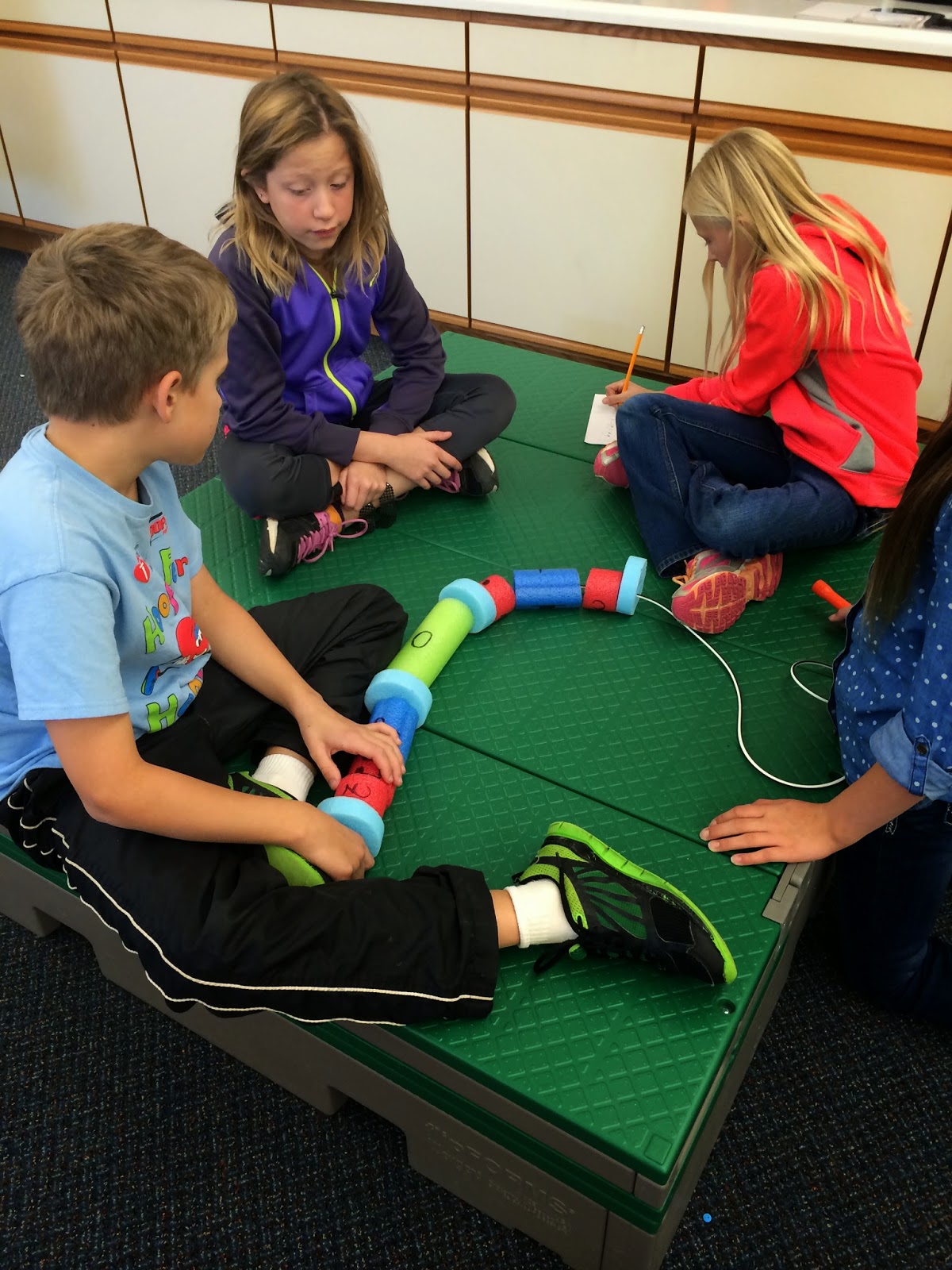
Noodle Notation: Using an idea I got from www.mrskingrocks.blogspot.com , I cut up a bunch of pool noodles that I bought at the dollar store this summer and made them into rhythms. The 5th graders had to compose rhythms in 3/4 and 4/4 time using the noodles.
 
 
Autumn Leaves: I have a bunch of autumn leaves laminated with different rhythms on them. Using those leaves, students created measures of 2/4, 3/4 and 4/4. Once they had finished, they notated their rhythms onto a worksheet.
 
Tasty Time Signatures: This will be my final assessment on time signatures for the students. It is as worksheet that I created. Since we are in the month of October and close to Halloween, I used the idea of candy rhythms. Students have to color each piece of candy to represent the meter it belongs in. I added in the rhythms after I printed it off. This way I can modify the worksheet to be easier or harder for different students/grade levels.
We are also doing some listening activities to identify whether a song is in duple or triple time. All of these activities will springboard us into our introduction to 6/8 time later this month.